 spire.
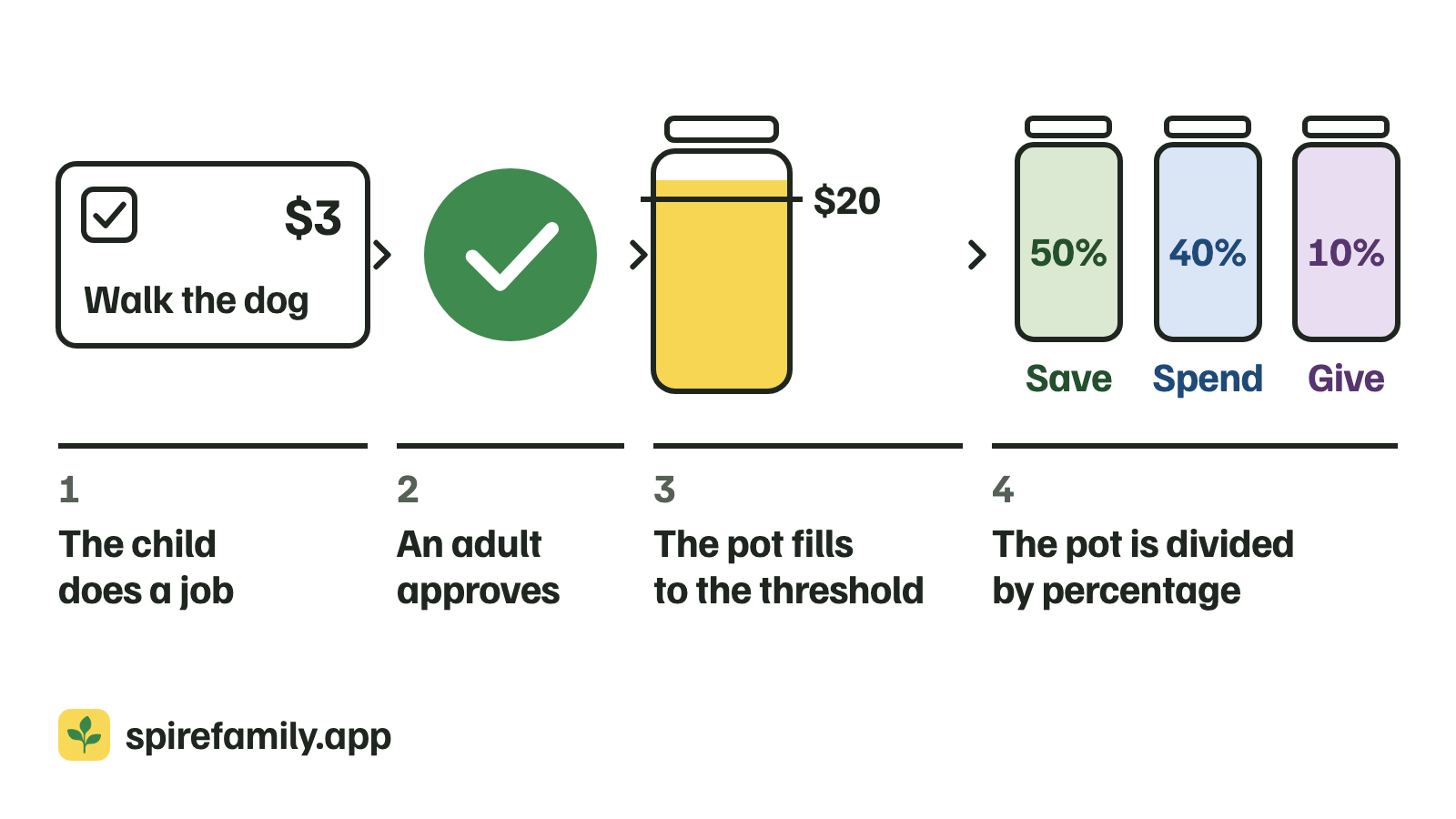
You can pay kids for chores without giving a fixed allowance. Pay only for jobs that help the rest of the family, such as cleaning the bathroom or walking the dog, and agree the amount for each job. What a child earns collects in a pot, and each time the pot reaches an amount you have set, it is split by fixed percentages between Save, Spend and Give. Everyday tasks that everyone does because they live there stay unpaid.
The idea is that money is something you get for work that is worth something to someone else. It is pocket money kids earn themselves. It needs no app. A list on the fridge, a sheet for the pot and three jars are enough, and the sheets can be printed.
Which chores should be paid, and which should not?
Make two lists together with the children.
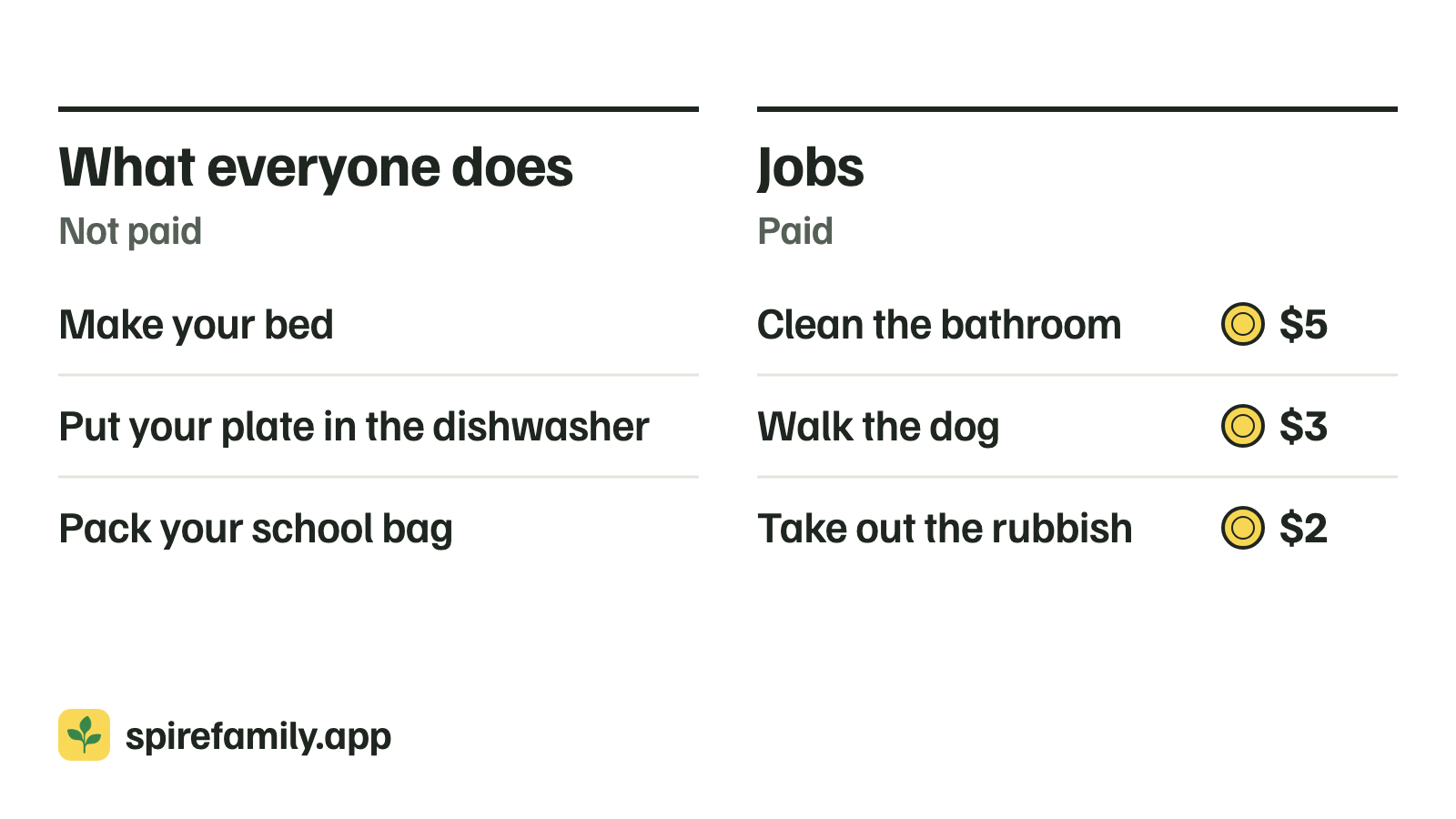
The first is what everyone does because they live there: make your bed, put your plate in the dishwasher, pack your school bag. Nobody is paid for these.
The second is jobs an adult would otherwise have to do: clean the bathroom, cook dinner, wash the car, walk the dog. These are paid. Children can suggest jobs themselves. An adult decides whether it becomes a job and sets the amount before the child starts.
Each family draws the line in its own place. Write it down, so it is the same next month.
How much to pay kids for chores
Put an amount next to each job, and say how often it can be done. The table shows examples in US dollars, not a recommendation.
| Job | Amount | How often |
|---|---|---|
| Clean the bathroom | $5 | Weekly |
| Walk the dog | $3 | Daily |
| Take out the rubbish | $2 | Weekly |
Choose amounts you can keep paying for a year, and pay bigger jobs more than small ones. For bigger jobs, agree what "done" means. For the bathroom, that might be the basin, the toilet and the floor.
How the pot and the split work
When a job is done and an adult has approved it, the amount goes into one pot. Nothing is divided until the pot reaches the threshold you chose, such as $20. Dividing $2 by percentages gives awkward coins, while $20 divides cleanly.
Decide the percentages for Save, Spend and Give once, for example 50, 40 and 10, and use the same split every time. When the pot passes the threshold, divide the threshold amount and leave the rest in the pot.
Spend is the child's to decide, within the family's usual rules. Give goes to something the child chooses, such as a charity or a school fundraiser. Dividing the pot is also a fixed time to talk about the money: what it was earned for and what it will be used for.
A worked example
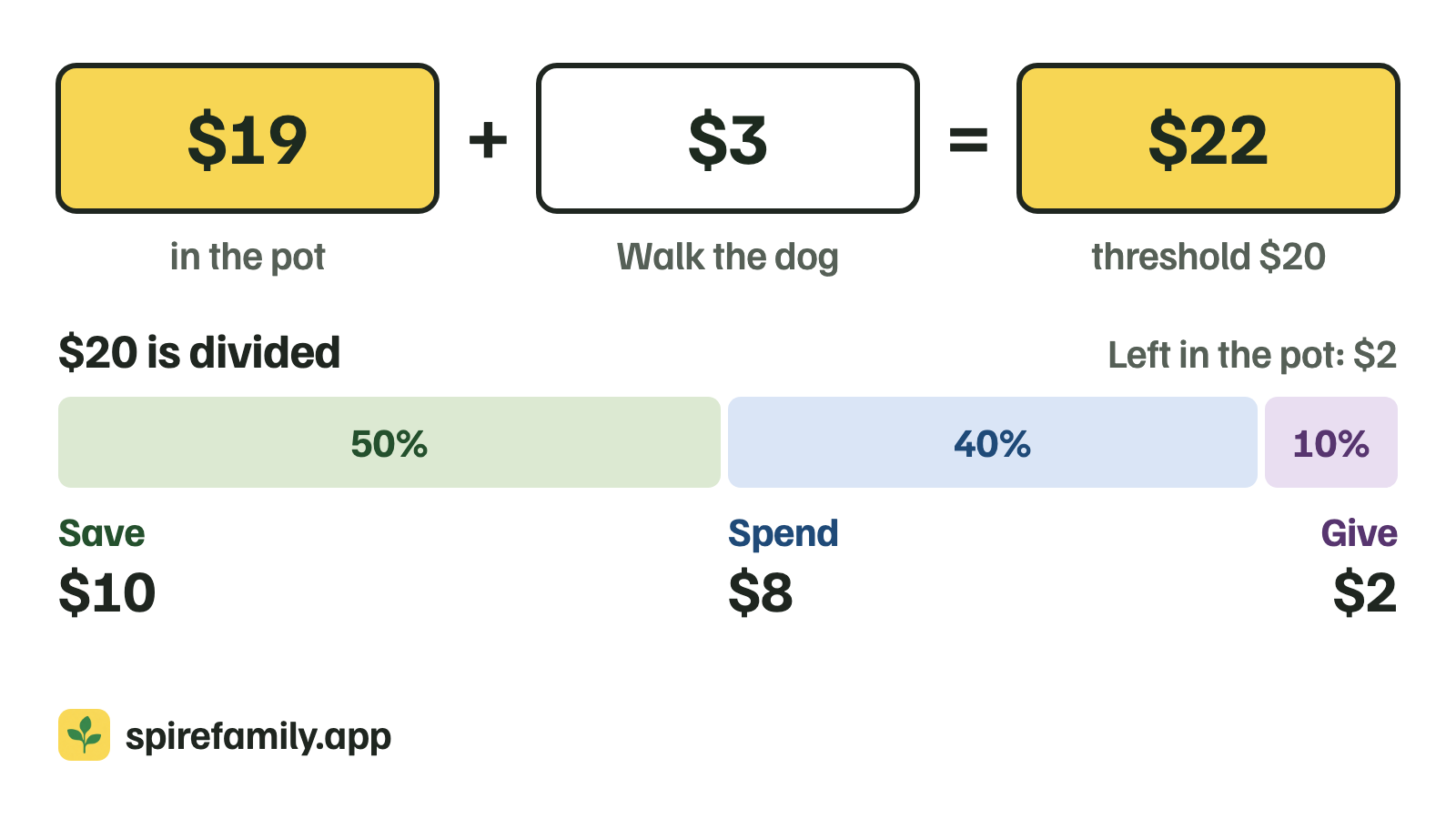
The threshold is $20 and the split is 50/40/10. The pot stands at $19. The child walks the dog, and an adult approves.
| Amount | |
|---|---|
| In the pot | $19 |
| Walk the dog | + $3 |
| The pot passes the threshold | $22 |
| To Save (50%) | $10 |
| To Spend (40%) | $8 |
| To Give (10%) | $2 |
| Left in the pot | $2 |
How to set a savings goal for kids
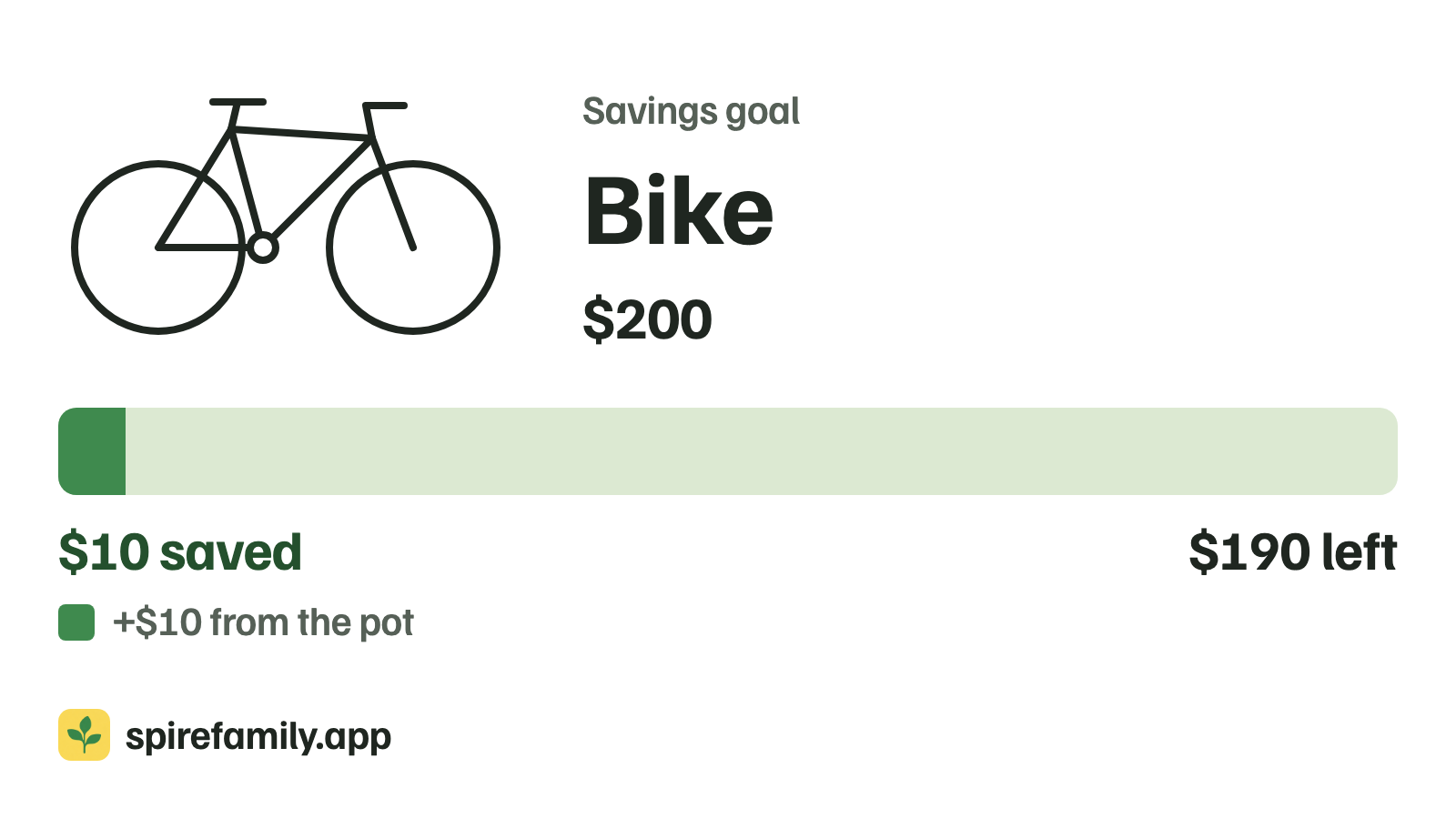
Write down what the child is saving for and what it costs. Each time money goes to Save, show how much is left. In the example, the child is saving for a bike that costs $200. After the first split, $10 is saved and $190 is left.
For the youngest children, choose a goal they can reach in a few weeks.
A chore chart with money you can print
The sheets for the fridge are three A4 pages: the two lists, a tally for the pot with date, job, amount and total, and labels for the three jars. Without an app, you count out cash when the pot reaches the threshold.
Common questions
Should kids get paid for chores?
Not for the everyday ones. Making your bed and clearing your plate are part of living in the house. The jobs that are paid are the ones that save someone else the work.
Should pocket money be earned or given?
In this method it is earned. There is no fixed amount, called an allowance in North America. A week with no jobs is a week with no money.
What percentage should kids save, spend and give?
There is no correct split. 50, 40 and 10 is one example. What matters is that you choose once and keep it, so it is not renegotiated every week.
What age is this for?
Children who can count money can take part. Give the youngest a low threshold and a savings goal that is close.
What if a child does no jobs?
Then nothing is earned that week. The first list still applies.
Can siblings share a job?
Yes. Agree beforehand that the amount is shared equally between the children who did it.
Do you need a chore app?
No. Paper and three jars are enough. An app can keep the pot, the split and the savings goal for you.
Why the method is built this way
The method is put together from parts that researchers have studied one by one.
What parents do and talk about matters most. In a US survey of 2,098 students, parents mattered more for how they handled money than work experience and school financial education combined (Shim et al., 2010). In PISA 2022, 15-year-olds who talked with their parents about their own purchases weekly or monthly scored 12 points higher in financial literacy than those who never did (OECD, 2024). That is why dividing the pot is a fixed time to talk about the money.
Everyday tasks are not paid. In a US study of 9,971 children, doing chores in kindergarten was linked with children rating their own academic ability and friendships higher in third grade, and with slightly higher maths scores (White et al., 2019). In a study that followed 456 men from age 14 to 47, capacity to work in childhood predicted success at work and mental health as an adult (Vaillant and Vaillant, 1981). Those tasks were not paid. In an experiment with 20-month-olds, children who had been given a reward for helping helped less afterwards than those who got praise or nothing (Warneken and Tomasello, 2008).
The money comes from jobs, not from a fixed amount. Researchers at the University of Cambridge point to small jobs at home as a way of making earning real for children, and write that younger children rarely see regular pocket money as a wage (Whitebread and Bingham, 2013). Among about 1,300 Dutch adults, pocket money on its own was not linked with more saving. Those who saved most had parents who also gave advice and kept an eye on spending (Bucciol and Veronesi, 2014). In PISA 2022, pocket money for regular chores was linked with lower scores in 10 of 20 countries. The OECD does not know whether those students talked with anyone about the money, which is why the conversation is part of the method.
The savings goal should be close. Seven-year-olds rarely judge time more than about a month ahead, while children from around eight can think in months (Whitebread and Bingham, 2013). In an experiment with four-year-olds, children waited four times as long for a bigger reward when the adult had kept an earlier promise (Kidd et al., 2013). That is why the pot is divided every time the threshold is reached.
Spire keeps the books
Spire is an app for iPhone and iPad that keeps track of this method. A parent creates each job with a reward, who can do it and how often. The child taps to say it is done on their own device, and a parent approves it. When the pot reaches the threshold, Spire divides the money between Save, Spend and Give by the percentages you chose, and both can differ for each child. Children can suggest jobs and create savings goals.
Spire does not hold or transfer money. You hand over the actual money as you do today, and the app records what each child has.

Sources
Read on 18 November 2026.
- Shim, S., Barber, B. L., Card, N. A., Xiao, J. J. and Serido, J. (2010). Financial Socialization of First-Year College Students: The Roles of Parents, Work, and Education. Journal of Youth and Adolescence 39, 1457–1470. https://doi.org/10.1007/s10964-009-9432-x
- OECD (2024). PISA 2022 Results (Volume IV): How Financially Smart Are Students? Chapter 7. https://www.oecd.org/content/dam/oecd/en/publications/reports/2024/06/pisa-2022-results-volume-iv_125a58b3/5a849c2a-en.pdf
- White, E. M., DeBoer, M. D. and Scharf, R. J. (2019). Associations Between Household Chores and Childhood Self-Competency. Journal of Developmental & Behavioral Pediatrics 40(3), 176–182. https://doi.org/10.1097/DBP.0000000000000637
- Vaillant, G. E. and Vaillant, C. O. (1981). Natural history of male psychological health, X: Work as a predictor of positive mental health. American Journal of Psychiatry 138(11), 1433–1440. https://doi.org/10.1176/ajp.138.11.1433
- Warneken, F. and Tomasello, M. (2008). Extrinsic rewards undermine altruistic tendencies in 20-month-olds. Developmental Psychology 44(6), 1785–1788. https://doi.org/10.1037/a0013860
- Whitebread, D. and Bingham, S. (2013). Habit Formation and Learning in Young Children. University of Cambridge, for the Money Advice Service. https://altorwealth.com/wp-content/uploads/2024/04/the-money-advice-service-habit-formation-and-learning-in-young-children-may2013.pdf
- Bucciol, A. and Veronesi, M. (2014). Teaching children to save: What is the best strategy for lifetime savings? Journal of Economic Psychology 45, 1–17. https://doi.org/10.1016/j.joep.2014.07.003
- Kidd, C., Palmeri, H. and Aslin, R. N. (2013). Rational snacking: Young children's decision-making on the marshmallow task is moderated by beliefs about environmental reliability. Cognition 126(1), 109–114. https://doi.org/10.1016/j.cognition.2012.08.004
Last updated 18 November 2026